


Ecological Monitoring of the Rota Vicentina Walking Trails (Part 4)
7 reading timeHow to Minimize the Negative Impacts of Walking Trails?
As part of the monitoring study of the Rota Vicentina walking trails, an updated literature review was conducted, analyzing technical reports and scientific articles produced over the last 10 years about the impacts of walking trails.
The study presents a summary of these sources and suggests some solutions to minimize the detected impacts.
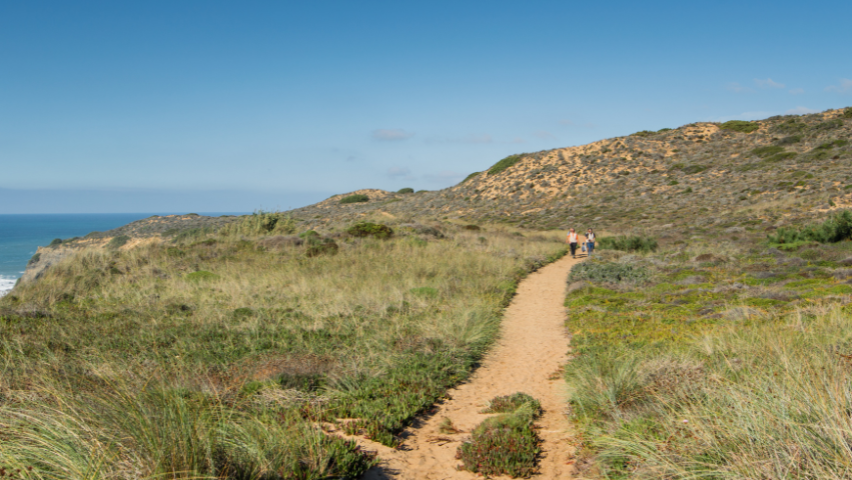
All trails have some unavoidable impact. The extent of the impact may vary, but certain negative effects are inevitable, such as the widening and deepening of trails.
Therefore, it is important to:
- Minimize predictable and preventable impacts.
- Implement actions to ensure positive impacts that offset inevitable negative impacts.
The impacts of walking trails on vegetation are well-identified and studied:
- Vegetation disappears completely on the trail (with some exceptions, such as grass meadows).
- Alongside the trail (on average, within 1 meter), vegetation may reduce its coverage or change its composition. Generalist species may increase along the trail’s edge, while more sensitive species may decline.
- In sandy soils, an opposite effect has been observed in some cases—an increase in coverage due to favorable soil compaction (better water retention capacity).
- Soil erosion can lead to root exposure.
- Invasive species may appear due to seed transport by hikers’ footwear.
- Plant diseases, such as pathogenic fungi, can also spread.
Among these impacts described in the literature, all are being monitored in Rota Vicentina, except for plant pathogens. The methodologies used are consistent with the studies consulted, allowing for comparisons. So far, only erosion with root exposure and trail widening/deepening have shown significant increases in certain segments.
Impacts on fauna are not being monitored in Rota Vicentina’s trails, as is the case with most hiking routes, except in sensitive areas for raptor nesting or other specific cases. Measuring fauna impacts is challenging and sometimes yields contradictory results. Most studies focus on mountainous or forested areas, often reporting different impacts for the same species depending on the country, methodology, or studied parameter.
Generally, impacts on fauna are short-term. For example, a bird may stop feeding and flee but return shortly afterward, expending extra energy. However, long-lasting impacts have been detected when new trail networks are created in areas without prior human presence. In such cases, territorial species may change hunting or breeding areas.
The Rota Vicentina, however, was developed using existing paths and trails already used by locals. Thus, it does not introduce disturbances where none existed before, though it does increase traffic frequency.
When opening new trails in areas without prior human presence:
- Animals increase vigilance and adopt escape behaviors as visitors approach.
- Some species may alter habitat selection and face challenges in acquiring resources.
- Parental care investment may increase, potentially reducing reproductive success.
- Most species eventually habituate to human presence.
Studies involving fauna have shown some positive impacts, such as trails being used for hunting or as corridors for nocturnal movement. Small passerines often nest closer to trails, possibly due to lower predator frequencies.
Walking with dogs has more impacts on fauna than walking alone. Interestingly, birdwatchers and nature photographers cause more disturbance than hikers due to their intrusive and approach-oriented behaviors.
Hiker behavior is a key aspect in minimizing impacts. Trail degradation and vegetation trampling can be confined to a narrow strip if hikers act responsibly and follow widely publicized trail-use rules.
What influences responsible behavior on trails?
Studies highlight several factors:
- Place attachment or a sense of belonging to a region encourages responsible behavior. Emotional connections with the landscape and people are the strongest determinants of trail behavior.
- Surprisingly, economic dependence on a region does not correlate with responsible behavior.
- People who recognize the impact of their actions on the planet and future generations tend to behave more responsibly. Those who incorporate environmental care into their daily routines are more responsible on trails.
- Individual characteristics also matter: older, more educated, and regular hikers show more responsible behavior.
- Poor trail conditions induce less responsible behavior.
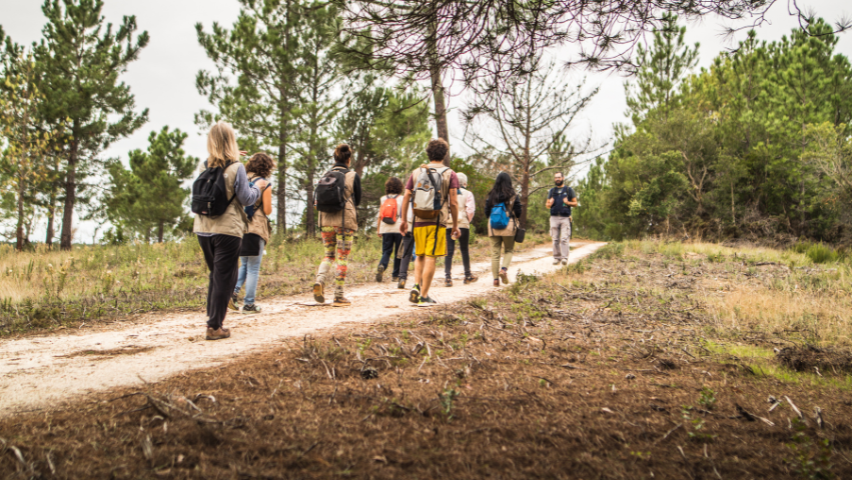
Several measures have been adopted globally to promote more responsible behavior among hikers:
- Investing in environmental education for all ages, not just youth.
- Adding low-impact educational messages on trails.
- Providing reminders at trailheads, such as waste containers, portable toilet kits, at the starting point. For example, at accommodations, at the departure point for hikers, provide trash containers or bathroom kits, or even have a conversation about the challenges of the trail and how to overcome them.
- Fostering connections with the area, e.g., encouraging longer stays. Local hosts can act as true ambassadors, promoting return visits, exploring less crowded routes, or visiting in different seasons.
The 2023 monitoring study also suggests solutions to minimize trail degradation and prevent the use of alternative trails.
Some alternative trails may be acceptable if they have sustainable designs and provide access to scenic views, shade, or water points. Attempting to close such trails is futile if people will continue to use them.
However, unacceptable alternative trails should be closed for conservation reasons using:
- Signs and symbolic fencing at entrances, made from lightweight materials.
- Branches and leaf litter to conceal the trail.
- Barriers at entrances, such as logs and branches.
Recreation ecology experts emphasize that it is impossible to maintain all trails without some degradation, making it essential to prioritize interventions. Strategies to prevent trail degradation include:
- Reinforcing substrates with materials to harden and stabilize them.
- Creating edges or fences to limit the trail.
- Draining areas prone to flooding.
- Cutting vegetation to make trails more visible.
- Building steps with natural materials (stone, wood) on slopes to prevent erosion and widening.
- Using crushed stone mixed with local soil, compacted to prevent erosion.
In summary, monitoring shows that, as predicted in 2013, increased foot traffic has caused some negative impacts on trails. However, these impacts are mostly confined to the trail and a narrow adjacent strip. Predicted impacts, such as changes in plant communities, have not yet materialized. The most sensitive habitats are dunes, characterized by sparse vegetation and loose, deep sand.
Rota Vicentina Association has implemented several mitigation measures, including invasive species control, volunteer activities, stage steward motivation and training, improved official trail signage, and communication strategies focused on environmental awareness.
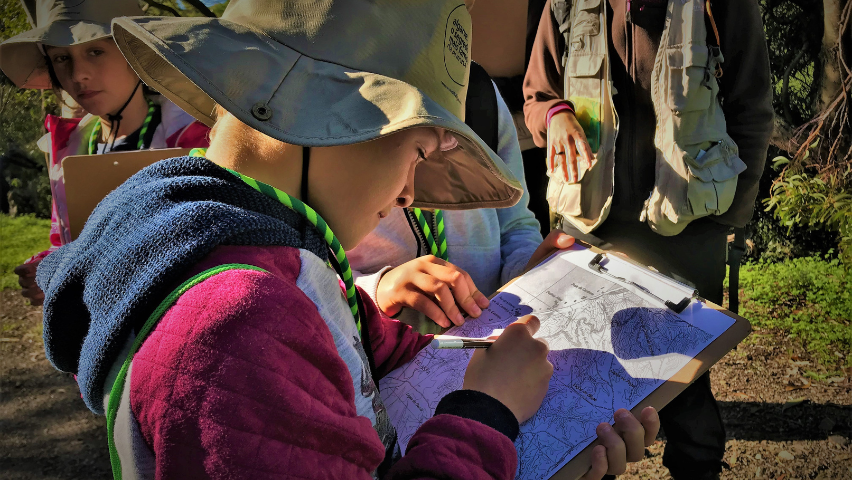
To participate, check the upcoming dates on the volunteer calendar or follow us on social media. See you soon! 🙂
Biologist, Master’s degree in Conservation Biology, teacher at the Secundary School of Odemira. She has has been living in the municipality Odemira since 1987. Her main interests are the knowledge, dissemination and preservation of the natural values of southwest Portugal. She has participated in numerous environmental studies, ecological monitoring works and natural values mapping. She […]
Our suggestions
Search by category
