


Ecological Monitoring of Rota Vicentina’s Walking Trails (Part 3)
4 reading timeVegetation Responses to Walking Trails
The bibliography consulted in 2013 regarding the impacts of walking trails mentioned changes in habitats and plant species within a variable-width strip alongside the trail.
These changes include, for example, an increase in invasive species, a decrease in species sensitive to trampling, an increase in more resilient species, or a reduction in the percentage of vegetation cover.
To measure these impacts on the Rota Vicentina, inventories were conducted in areas measuring 3 meters in width and 10 meters in length alongside the trails, covering locations that include 12 dune habitats, 4 of which are classified as conservation priorities. In these inventories, all existing species and their coverage degree within the sampling rectangle are recorded. These data are compared over time: samples were taken in 2013 (year zero), 2017, and 2023.
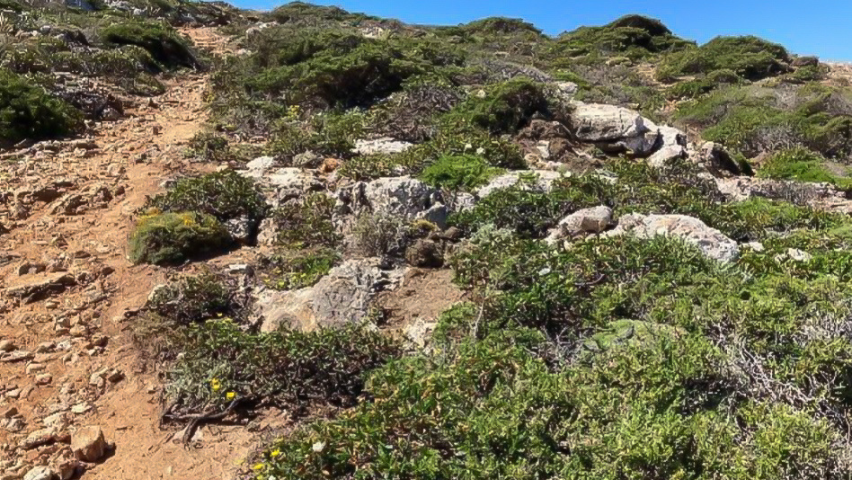
The sampling strips alongside the trail are identified using GPS coordinates and marked with stakes
However, to understand whether the differences observed in these vegetation inventories are due to the presence of walkers or other factors, it is necessary to have control sampling sites, i.e., locations with the same characteristics but away from the walking trails.
Thus, if a species decreases its coverage near the trail but not in the control site, we can attribute this difference to the impacts of walkers. If a species disappears from the sampling near the trail but also in the control sampling, then other factors, such as atypical climatic events, may be causing this disappearance.
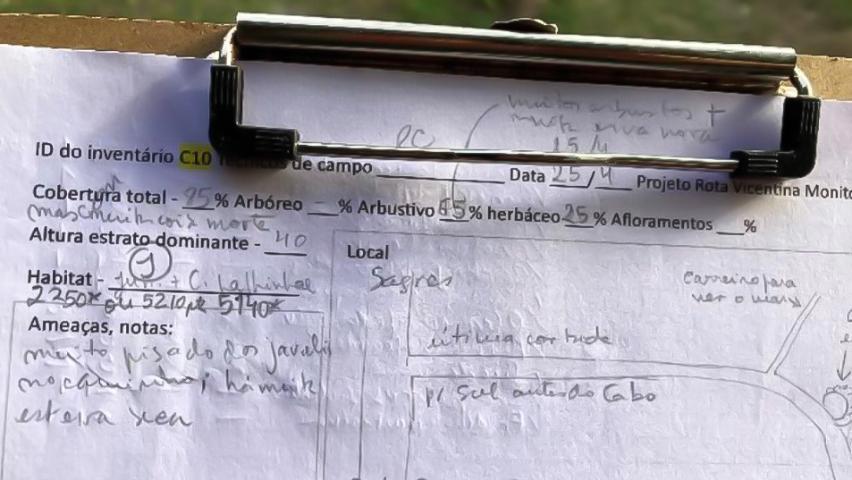
In addition to the defined indicators, existing threats—related or unrelated to the trails—were recorded
A total of 34 inventories were conducted, generating a vast amount of data, which were processed using statistical methods appropriate for each indicator. Some conclusions from these analyses include:
- Invasive plants are naturally expanding their area of occupation and dispersing, possibly with some human assistance, both in areas near the trails and in the control sites. This increase leads to the loss of native species, some of which are rare and protected. The data do not indicate a correlation between trail use by walkers and an increase in biological invasion phenomena by vascular plant species; the expansion of invasive plants is occurring similarly both near and far from the trails.
- Across all inventories, 34 protected or rare species were recorded. From 2013 to 2023, most species showed a decline in presence and abundance in both control and experimental inventories. This was the case for the endemic southwestern thyme, Thymus camphoratus. Os exemplares vivos encontravam-se com a maior parte dos ramos secos, o que se deverá provavelmente às amplitudes térmicas atípicas da primavera de 2023 e ainda à escassez de precipitação. Contudo, outras espécies protegidas, como The living specimens were found with most branches dried out, likely due to the atypical thermal amplitudes of spring 2023 and the lack of precipitation. However, other protected species, such as Biscutella vicentina and Linaria ficalhoana, appear to have benefited from the atypical climate conditions of 2023, as their abundance increased.
- Some inventories revealed considerable structural differences, but the causes were evident on-site: forestry and agricultural operations (observed in Serra de S. Luís and the agricultural area between Sagres and Vila do Bispo), off-road vehicle activity on the dunes, wild boar rooting, increased cover of invasive species (notably Acacia spp.), and atypical climatic condition. Regarding the latter, it was observed, for example, that many plants dried out before their fruits matured, compromising the production of viable seeds. These phenomena were observed both near the trails and in the control sites.
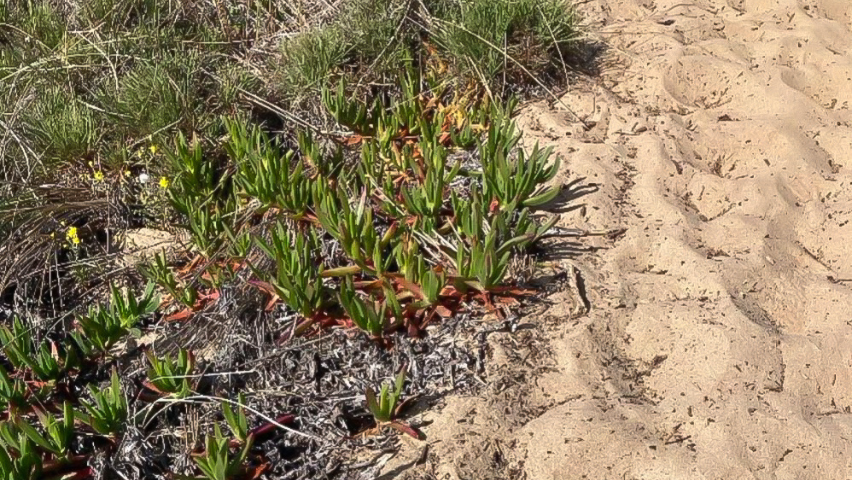
Some protected plants benefited from the small clearings opened alongside certain trails, such as the southwestern goosefoot (Chenopodium ambrosioides)
Biologist, Master’s degree in Conservation Biology, teacher at the Secundary School of Odemira. She has has been living in the municipality Odemira since 1987. Her main interests are the knowledge, dissemination and preservation of the natural values of southwest Portugal. She has participated in numerous environmental studies, ecological monitoring works and natural values mapping. She […]
Our suggestions
Search by category
